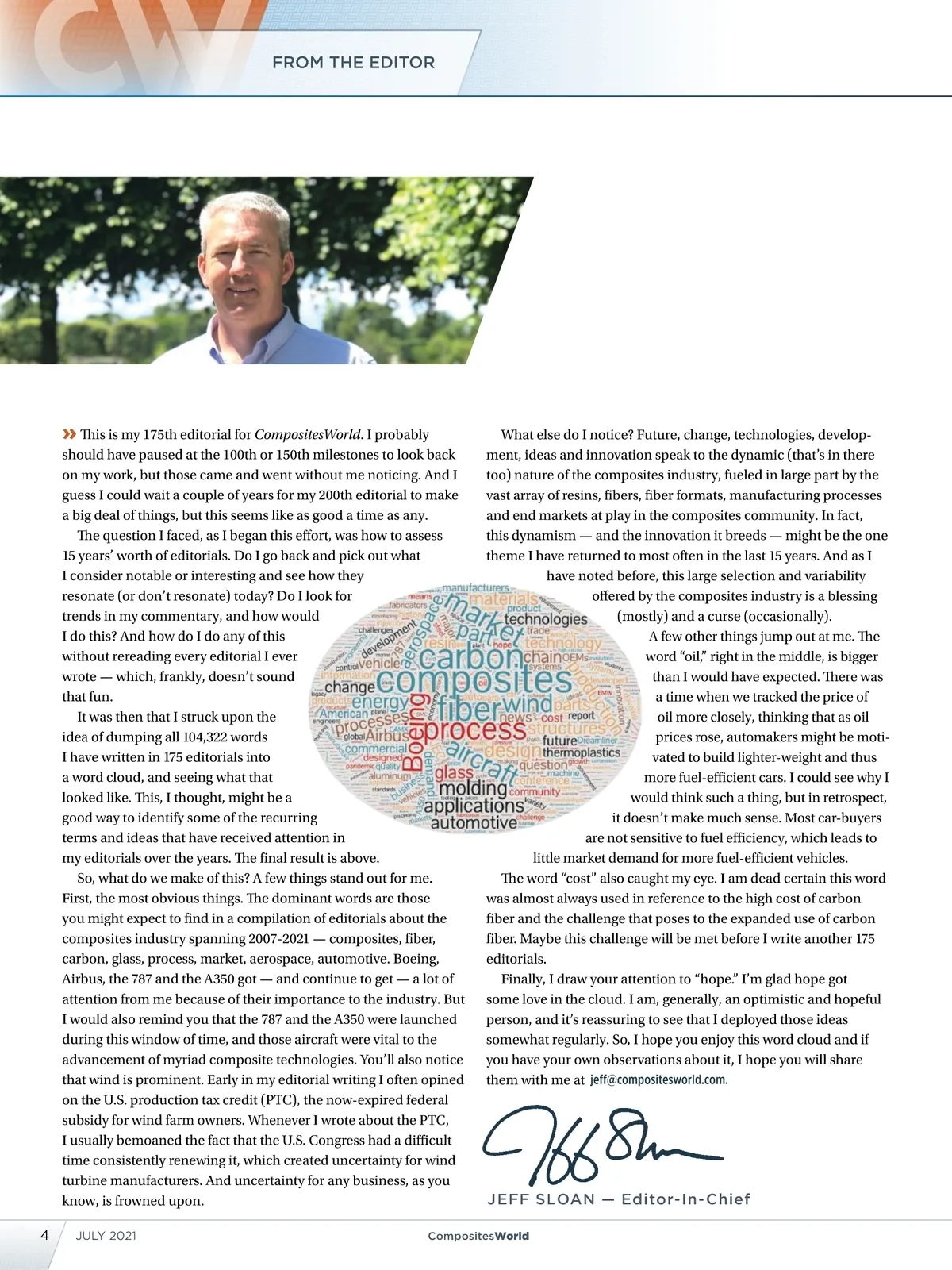
FROM THE EDITOR » is is my 175th editorial for CompositesWorld . I probably should have paused at the 100th or 150th milestones to look back on my work, but those came and went without me noticing. And I guess I could wait a couple of years for my 200th editorial to make a big deal of things, but this seems like as good a time as any. e question I faced, as I began this e ort, was how to assess years’ worth of editorials. Do I go back and pick out what I consider notable or interesting and see how they resonate (or don’t resonate) today? Do I look for trends in my commentary, and how would I do this? And how do I do any of this without rereading every editorial I ever wrote — which, frankly, doesn’t sound that fun. It was then that I struck upon the idea of dumping all , words I have written in editorials into a word cloud, and seeing what that looked like. is, I thought, might be a good way to identify some of the recurring terms and ideas that have received attention in my editorials over the years. e nal result is above. So, what do we make of this? A few things stand out for me. First, the most obvious things. e dominant words are those you might expect to nd in a compilation of editorials about the composites industry spanning - — composites, ber, carbon, glass, process, market, aerospace, automotive. Boeing, Airbus, the and the A got — and continue to get — a lot of attention from me because of their importance to the industry. But I would also remind you that the and the A were launched during this window of time, and those aircraft were vital to the advancement of myriad composite technologies. You’ll also notice that wind is prominent. Early in my editorial writing I often opined on the U.S. production tax credit (PTC), the now-expired federal subsidy for wind farm owners. Whenever I wrote about the PTC, I usually bemoaned the fact that the U.S. Congress had a di cult time consistently renewing it, which created uncertainty for wind turbine manufacturers. And uncertainty for any business, as you know, is frowned upon. JULY 2021 What else do I notice? Future, change, technologies, develop-ment, ideas and innovation speak to the dynamic (that’s in there too) nature of the composites industry, fueled in large part by the vast array of resins, bers, ber formats, manufacturing processes and end markets at play in the composites community. In fact, this dynamism — and the innovation it breeds — might be the one theme I have returned to most often in the last years. And as I have noted before, this large selection and variability o ered by the composites industry is a blessing (mostly) and a curse (occasionally). A few other things jump out at me. e word “oil,” right in the middle, is bigger than I would have expected. ere was a time when we tracked the price of oil more closely, thinking that as oil prices rose, automakers might be moti-vated to build lighter-weight and thus more fuel-e cient cars. I could see why I would think such a thing, but in retrospect, it doesn’t make much sense. Most car-buyers are not sensitive to fuel e ciency, which leads to little market demand for more fuel-e cient vehicles. e word “cost” also caught my eye. I am dead certain this word was almost always used in reference to the high cost of carbon ber and the challenge that poses to the expanded use of carbon ber. Maybe this challenge will be met before I write another editorials. Finally, I draw your attention to “hope.” I’m glad hope got some love in the cloud. I am, generally, an optimistic and hopeful person, and it’s reassuring to see that I deployed those ideas somewhat regularly. So, I hope you enjoy this word cloud and if you have your own observations about it, I hope you will share them with me at je @compositesworld.com. JEFF SLOAN — Editor-In-Chief 4 Composites World
CompositesWorld CompositesWorld - July 2021: Page 4