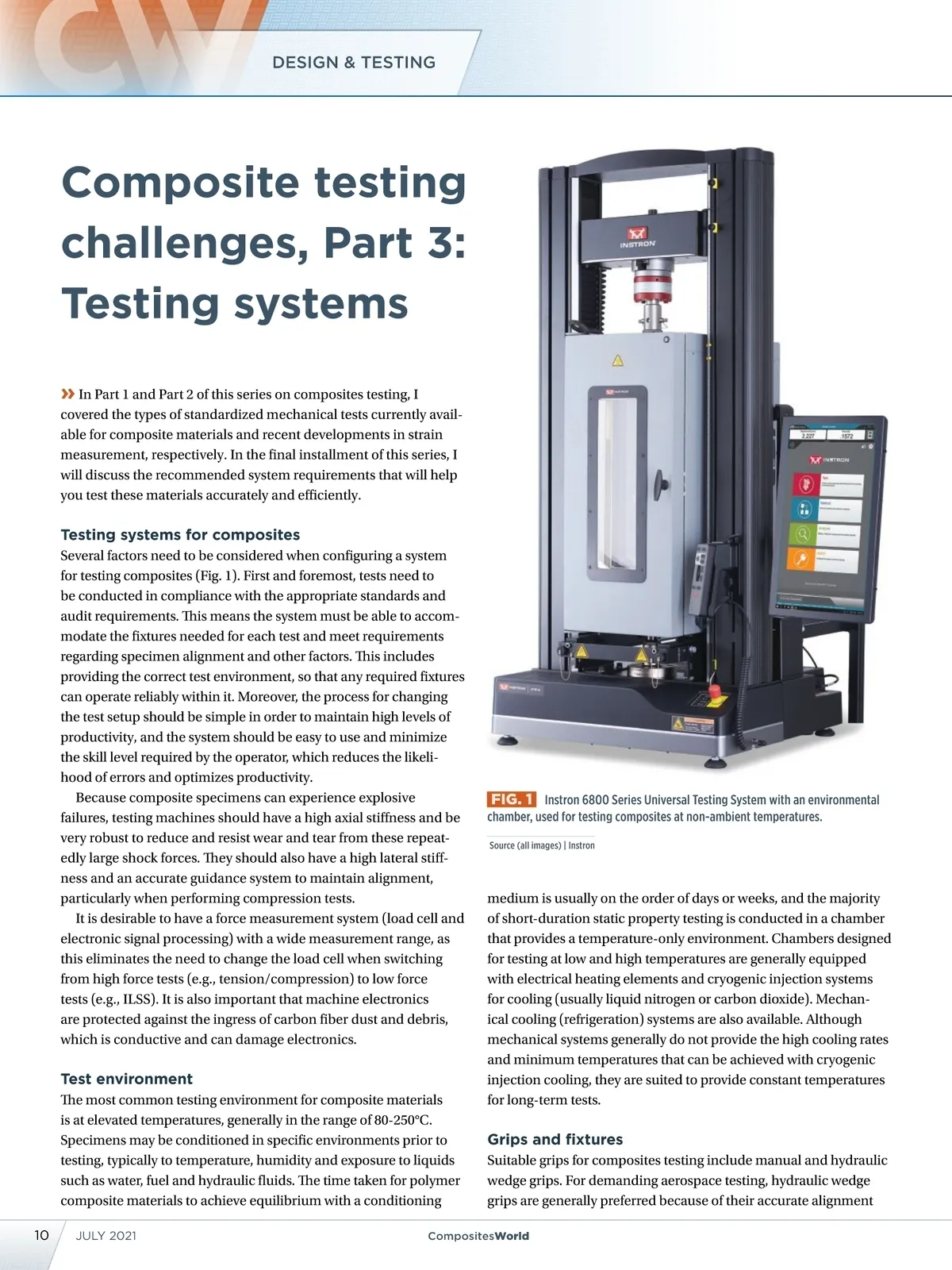
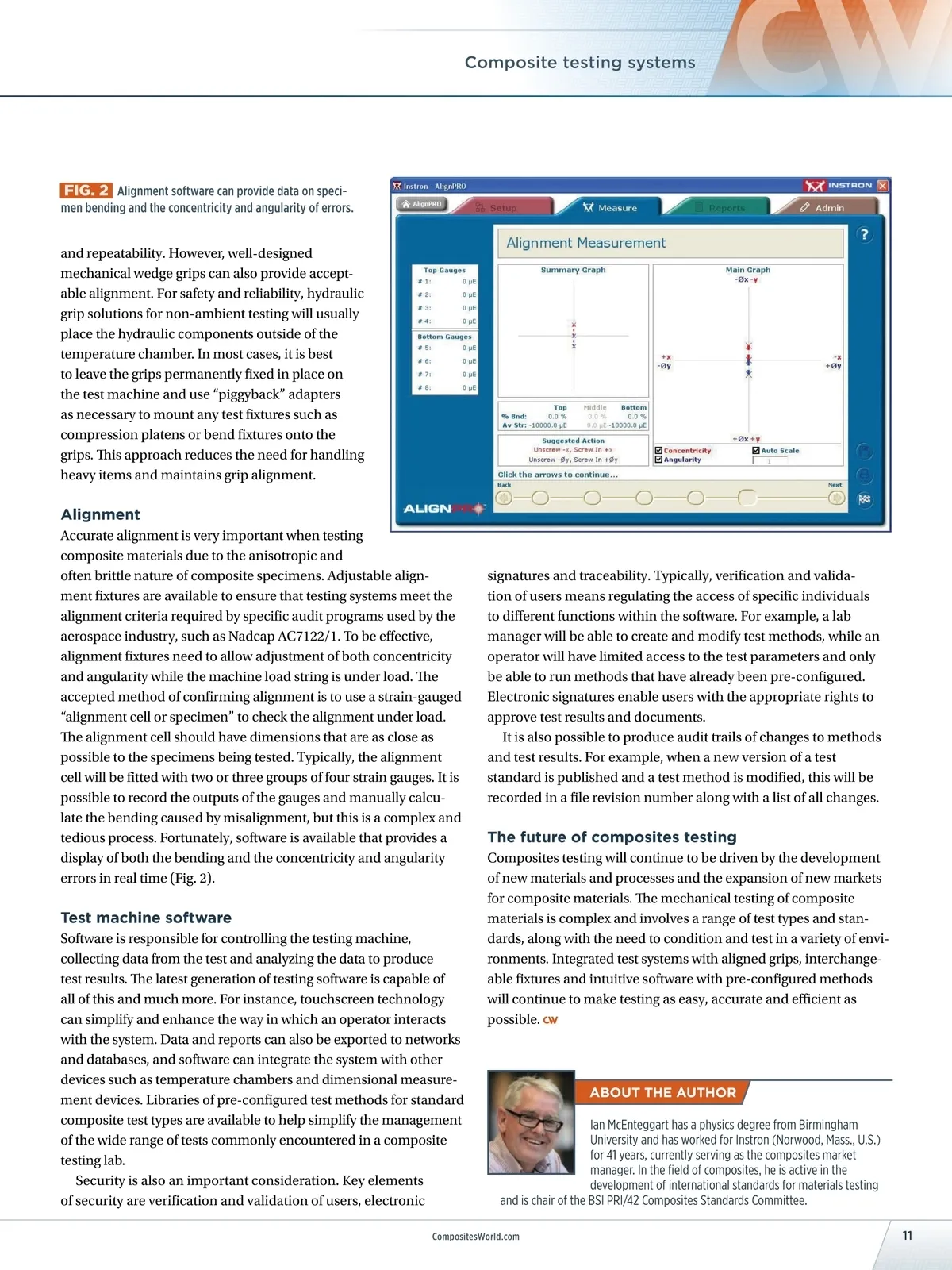
DESIGN & TESTING Composite testing challenges, Part 3: Testing systems » In Part and Part of this series on composites testing, I covered the types of standardized mechanical tests currently avail-able for composite materials and recent developments in strain measurement, respectively. In the nal installment of this series, I will discuss the recommended system requirements that will help you test these materials accurately and e ciently. Testing systems for composites Several factors need to be considered when con guring a system for testing composites (Fig. 1). First and foremost, tests need to be conducted in compliance with the appropriate standards and audit requirements. is means the system must be able to accom-modate the xtures needed for each test and meet requirements regarding specimen alignment and other factors. is includes providing the correct test environment, so that any required xtures can operate reliably within it. Moreover, the process for changing the test setup should be simple in order to maintain high levels of productivity, and the system should be easy to use and minimize the skill level required by the operator, which reduces the likeli-hood of errors and optimizes productivity. Because composite specimens can experience explosive failures, testing machines should have a high axial sti ness and be very robust to reduce and resist wear and tear from these repeat-edly large shock forces. ey should also have a high lateral sti -ness and an accurate guidance system to maintain alignment, particularly when performing compression tests. It is desirable to have a force measurement system (load cell and electronic signal processing) with a wide measurement range, as this eliminates the need to change the load cell when switching from high force tests (e.g., tension/compression) to low force tests (e.g., ILSS). It is also important that machine electronics are protected against the ingress of carbon ber dust and debris, which is conductive and can damage electronics. FIG. 1 Instron 6800 Series Universal Testing System with an environmental chamber, used for testing composites at non-ambient temperatures. Source (all images) | Instron Test environment e most common testing environment for composite materials is at elevated temperatures, generally in the range of 80-250°C. Specimens may be conditioned in speci c environments prior to testing, typically to temperature, humidity and exposure to liquids such as water, fuel and hydraulic uids. e time taken for polymer composite materials to achieve equilibrium with a conditioning 10 JULY 2021 medium is usually on the order of days or weeks, and the majority of short-duration static property testing is conducted in a chamber that provides a temperature-only environment. Chambers designed for testing at low and high temperatures are generally equipped with electrical heating elements and cryogenic injection systems for cooling (usually liquid nitrogen or carbon dioxide). Mechan-ical cooling (refrigeration) systems are also available. Although mechanical systems generally do not provide the high cooling rates and minimum temperatures that can be achieved with cryogenic injection cooling, they are suited to provide constant temperatures for long-term tests. Grips and fi xtures Suitable grips for composites testing include manual and hydraulic wedge grips. For demanding aerospace testing, hydraulic wedge grips are generally preferred because of their accurate alignment Composites World
CompositesWorld CompositesWorld - July 2021: Page 10