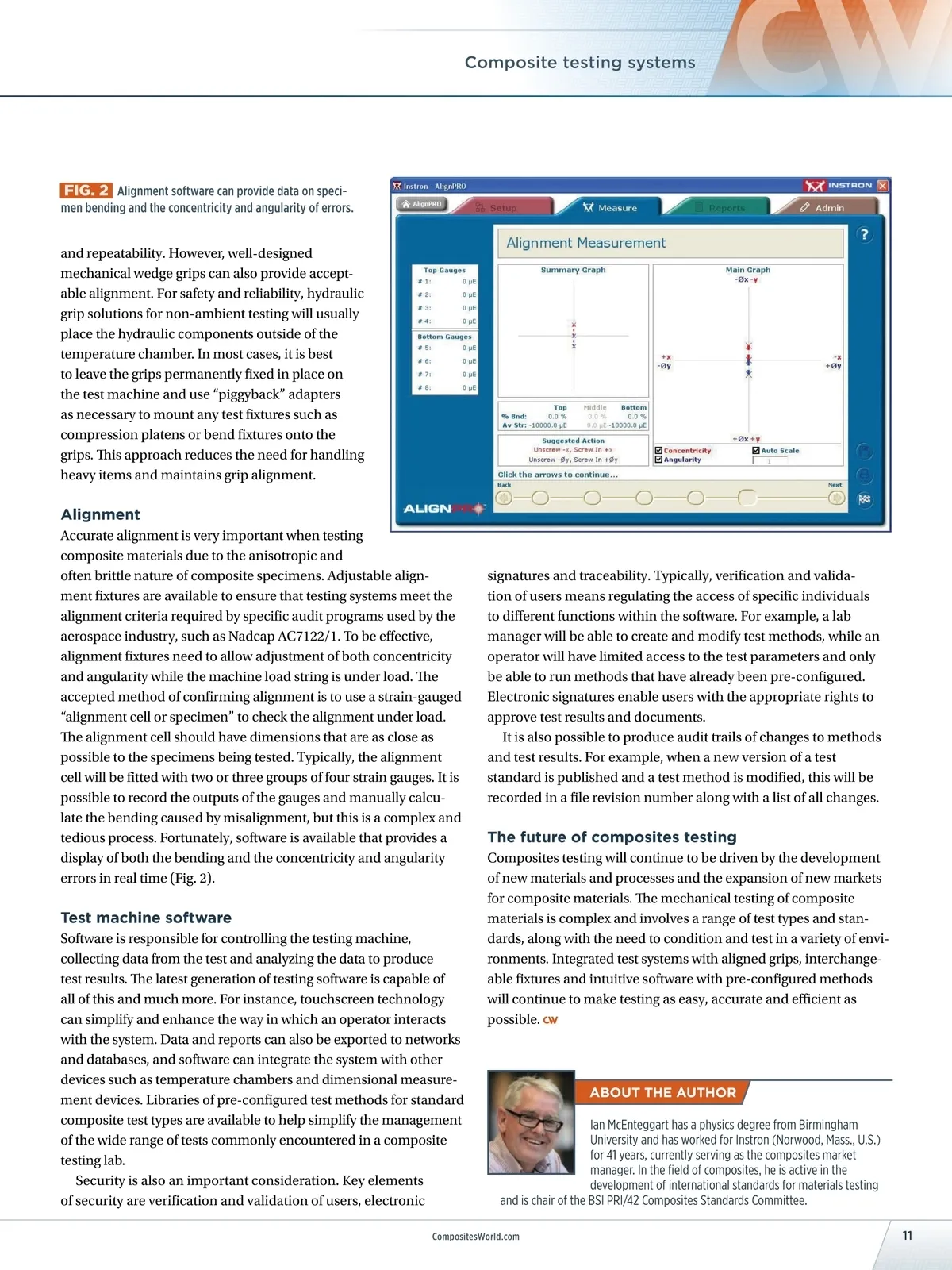
Composite testing systems FIG. 2 Alignment software can provide data on speci-men bending and the concentricity and angularity of errors. and repeatability. However, well-designed mechanical wedge grips can also provide accept-able alignment. For safety and reliability, hydraulic grip solutions for non-ambient testing will usually place the hydraulic components outside of the temperature chamber. In most cases, it is best to leave the grips permanently xed in place on the test machine and use “piggyback” adapters as necessary to mount any test xtures such as compression platens or bend xtures onto the grips. is approach reduces the need for handling heavy items and maintains grip alignment. Alignment Accurate alignment is very important when testing composite materials due to the anisotropic and often brittle nature of composite specimens. Adjustable align-ment xtures are available to ensure that testing systems meet the alignment criteria required by speci c audit programs used by the aerospace industry, such as Nadcap AC7122/1. To be e ective, alignment xtures need to allow adjustment of both concentricity and angularity while the machine load string is under load. e accepted method of con rming alignment is to use a strain-gauged “alignment cell or specimen” to check the alignment under load. e alignment cell should have dimensions that are as close as possible to the specimens being tested. Typically, the alignment cell will be tted with two or three groups of four strain gauges. It is possible to record the outputs of the gauges and manually calcu-late the bending caused by misalignment, but this is a complex and tedious process. Fortunately, software is available that provides a display of both the bending and the concentricity and angularity errors in real time (Fig. 2). signatures and traceability. Typically, veri cation and valida-tion of users means regulating the access of speci c individuals to di erent functions within the software. For example, a lab manager will be able to create and modify test methods, while an operator will have limited access to the test parameters and only be able to run methods that have already been pre-con gured. Electronic signatures enable users with the appropriate rights to approve test results and documents. It is also possible to produce audit trails of changes to methods and test results. For example, when a new version of a test standard is published and a test method is modi ed, this will be recorded in a le revision number along with a list of all changes. The future of composites testing Composites testing will continue to be driven by the development of new materials and processes and the expansion of new markets for composite materials. e mechanical testing of composite materials is complex and involves a range of test types and stan-dards, along with the need to condition and test in a variety of envi-ronments. Integrated test systems with aligned grips, interchange-able xtures and intuitive software with pre-con gured methods will continue to make testing as easy, accurate and e cient as possible. Test machine software Software is responsible for controlling the testing machine, collecting data from the test and analyzing the data to produce test results. e latest generation of testing software is capable of all of this and much more. For instance, touchscreen technology can simplify and enhance the way in which an operator interacts with the system. Data and reports can also be exported to networks and databases, and software can integrate the system with other devices such as temperature chambers and dimensional measure-ment devices. Libraries of pre-con gured test methods for standard composite test types are available to help simplify the management of the wide range of tests commonly encountered in a composite testing lab. Security is also an important consideration. Key elements of security are veri cation and validation of users, electronic ABOUT THE AUTHOR Ian McEnteggart has a physics degree from Birmingham University and has worked for Instron (Norwood, Mass., U.S.) for 41 years, currently serving as the composites market manager. In the fi eld of composites, he is active in the development of international standards for materials testing and is chair of the BSI PRI/42 Composites Standards Committee. 11 CompositesWorld.com
CompositesWorld CompositesWorld - July 2021: Page 11